
My mother was a runner. She ran in all the big races around San Francisco back then, including the “Bay to Breakers”, the one that wound all through Golden Gate Park and caused all kinds of traffic headaches for people just trying to live in the city. She had a stack of paper numbers she kept in the rolltop desk in the foyer, mementos from her running days.
My mother had powerful legs for a small Mexican woman; sinewy and with deep trenches between the muscles. I can’t see a woman running beside the road without thinking of her pastel rayon running shorts that made a zip-zip noise with the friction of her legs as they passed by each other; her limp hands held loosely in front of her; the changing musculature of the tendons and muscles in her legs as they pumped away.
My mother who ate virtually nothing and yet ran marathons. My mother, perpetually dehydrated and hungover and unhappy, who could outpace a thoroughbred.
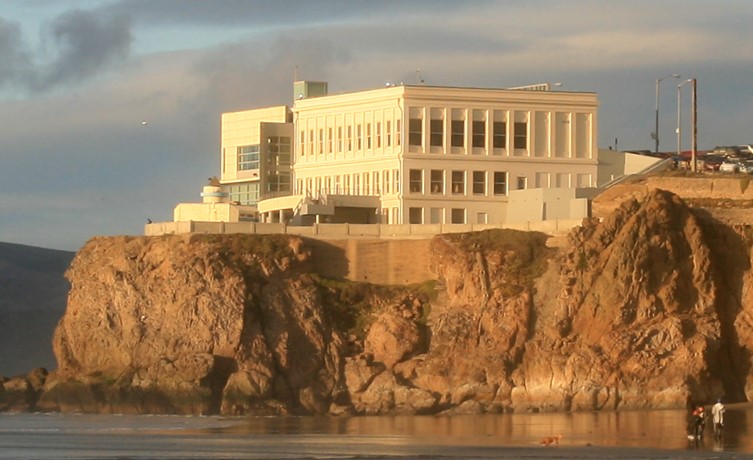
Every weekend, usually on Sunday, she took me with her running along the trail next to Ocean Beach. We’d park at the southern end, near the zoo. I’d ride my bike or I’d skate or scooter and we’d go all the way up to the cliffhouse, which was a shadow of its glory days. Then I’d stay at the Cliffhouse, in the penny arcade, playing video games and annoying the security guard, and she’d run back to our car, then back to the cliffhouse to get me. Then we’d go back to the car, taking breaks a few times because I was fat and asthmatic.
Sometimes when I was left alone at the cliffhouse, I’d wander out of the arcade, to the edge of the Sutro bath ruins. On the north side of the cliffhouse were a series of stone walls that marked out buildings and rooms and a massive pool area, all flooded halfway up the walls with green water. The baths looked like something ancient and Roman, but they’d been open to the public as recently as the early 1900s. Several plaques stood around the pathway that ran by the largest pool. They had the history of the baths, of which I can only remember that they could house 10,000 people at a time and were created by Adolph Sutro, who I only remember because his name is Adolph and that was notable to me because I thought that’d be a tough break, to be named Adolph.
I played around the baths and the security guard would sometimes yell at me, but only half-heartedly. I was too full of fear to tread anywhere truly dangerous, like on the walls where there was no support, where I’d have to depend on my weak sense of balance to keep me from falling into the green filthy water on either side. So he never made too much fuss, though he’d tell my mother sometimes when she came to get me. She never seemed to care about it. It’s funny the things she did care about; I’d get a hard slap across the face if I threw toys in my closet instead of putting them back where they belonged, but harassing a security guard didn’t even warrant a raised eyebrow.
Once, on our way back from the cliffhouse, we saw a drowned man on the beach. He’d been surfing with his friends in the frigid water and he’d hit his head or something. His friends had probably been laughing while he tumbled around under them, smacking his head open on sharp rocks, wondering if this was really going to be it. And it was for him. We got there as two men were hauling him up the beach by the armpits, and we stood there, my mother and me, about thirty feet away while they performed CPR or some improvised thing that looked like it, while panicking and repeating the same things over and over. “Hang in there”, seemed to be the most often repeated. “Hang in there, Sam.”
“It’s going to be alright, it’s going to be fine,” was another thing they said over and over. It feels good to say that to yourself when things get bad, of course. They said it with conviction, so much so that if there really was power in words, if vibrations in the air could calm a storm and stop bullets, it would have happened right there, it would have brought Sam back to life.
There was a sign hanging in my first wife’s aunt’s house that said “It’s already okay.” I imagine if they’d seen that sign at that moment, they’d get the urge to tear it off the wall and throw it out the front door into the street, like I do whenever I saw it from the corner of my eye while we had dinner there.
“Everything will be fine in the end; if it’s not fine, then it’s not the end,” has a similar sort of feel to it, but it’s more truthful. If you wait long enough, things, maybe just in the local area, not important things, but some things, are going to be fine. Just before they go back to the much more natural state of chaos and panic and wondering how we’d all just been laughing and now someone was dead.
It doesn’t quite feel like an emergency situation until there are sirens and people telling you to move along or get out of the way. They came after Sam’s friends had given up, the professionals did I mean, and they checked Sam over and must have agreed that he was no longer Sam, just a thing lying there on the beach, and then they put him on a stretcher and carried him up to the ambulance. Nothing could be done. His eyes were closed and his skin was a little greyer than a living person who had just been swimming in a cold ocean, but he didn’t look so bad. But he was dead all the same. They turned off the siren before they drove away.
My mother and I walked the whole way back to the car, not talking about what we saw. She didn’t run and I didn’t ride my bike or scooter or whatever. We were our own little two-person, side-by-side funerary march, just staring slightly down and toward the car at the far end of the beach. I was too young, I think, to really feel any way about what I’d seen. I hadn’t known Sam and it hadn’t been, I think I realized, such a bad way to go, really. Maybe I give my young malformed brain too much credit, maybe I was really just too stupid to comprehend a life being lost near me. And I think my mother was afraid that I was going to ask her some big existential questions and so she just kept quiet. Maybe she was giving me space to talk in, maybe she was just dumbfounded. She wasn’t crying, at least.
We got back to the car after what seemed like years and we got in and she didn’t start it right away, we just sat there. And then I said “Wow, that was something,” and she sort of half-smiled a little and started up the car and put on the radio. We pulled out of the lot and went home. I’ve never talked to my mother about that whole thing, but I know she talked to my dad about it later, because I’ve been married and that’s what I would do if it happened to me. Maybe she cried then, maybe my dad said “Well, probably not that bad of a way to go,” and she punched him in the shoulder. Maybe in twenty years, I’ll remember that I saw this conversation happen, or that I cried about it later.
Maybe I’ll think about in my own final moments, lying on a clean hospital bed surrounded by adoring family, or as my bent and twisted body bleeds out in front of a city bus with a me-shaped dent in the front bumper. Or, more likely, as I lay alone on my bathroom floor with my heart seized up in my chest like a double-knotted shoelace.
Maybe not.
Leave a Reply